POWER AND CONFLICT
War Photographer
Making suffering visible does not guarantee that distant viewers will accept responsibility.
Read the accessible text and study notes
What happens?
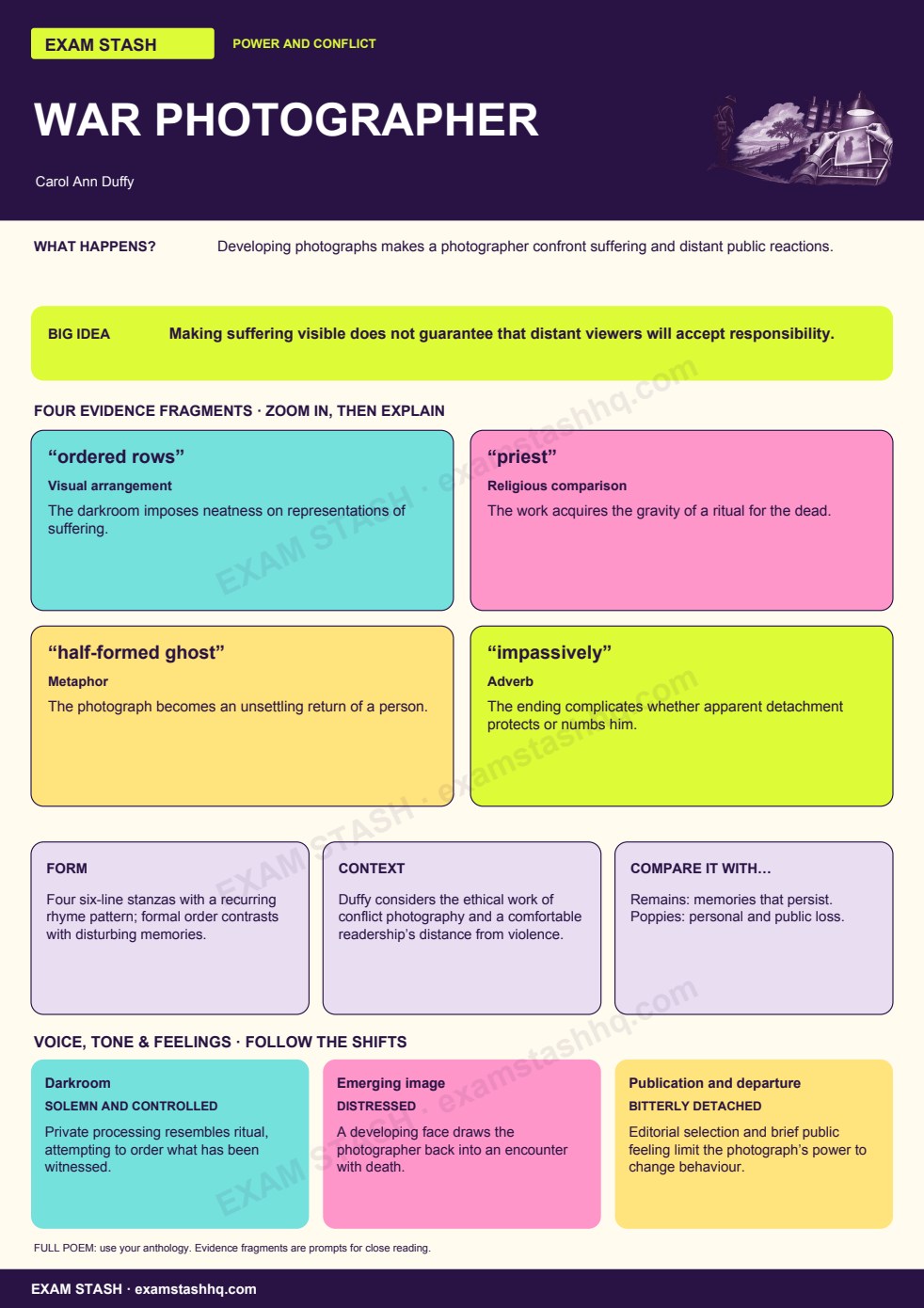
Developing photographs makes a photographer confront suffering and distant public reactions.
Big idea
Making suffering visible does not guarantee that distant viewers will accept responsibility.
“ordered rows”
Visual arrangement — The darkroom imposes neatness on representations of suffering.
“priest”
Religious comparison — The work acquires the gravity of a ritual for the dead.
“half-formed ghost”
Metaphor — The photograph becomes an unsettling return of a person.
“impassively”
Adverb — The ending complicates whether apparent detachment protects or numbs him.
Form
Four six-line stanzas with a recurring rhyme pattern; formal order contrasts with disturbing memories.
Context
Duffy considers the ethical work of conflict photography and a comfortable readership’s distance from violence.
Compare
Remains: memories that persist. Poppies: personal and public loss.
Voice, tone and feelings
Darkroom · Solemn and controlled — Private processing resembles ritual, attempting to order what has been witnessed.
Emerging image · Distressed — A developing face draws the photographer back into an encounter with death.
Publication and departure · Bitterly detached — Editorial selection and brief public feeling limit the photograph’s power to change behaviour.
Recall
How does the orderly form complicate the subject matter?
Read the full poem in your own AQA anthology. Anthology information and source.