WORLDS AND LIVES
Thirteen
Racialised suspicion can make a child’s public promise of a future feel conditional and unsafe.
Read the accessible text and study notes
What happens?
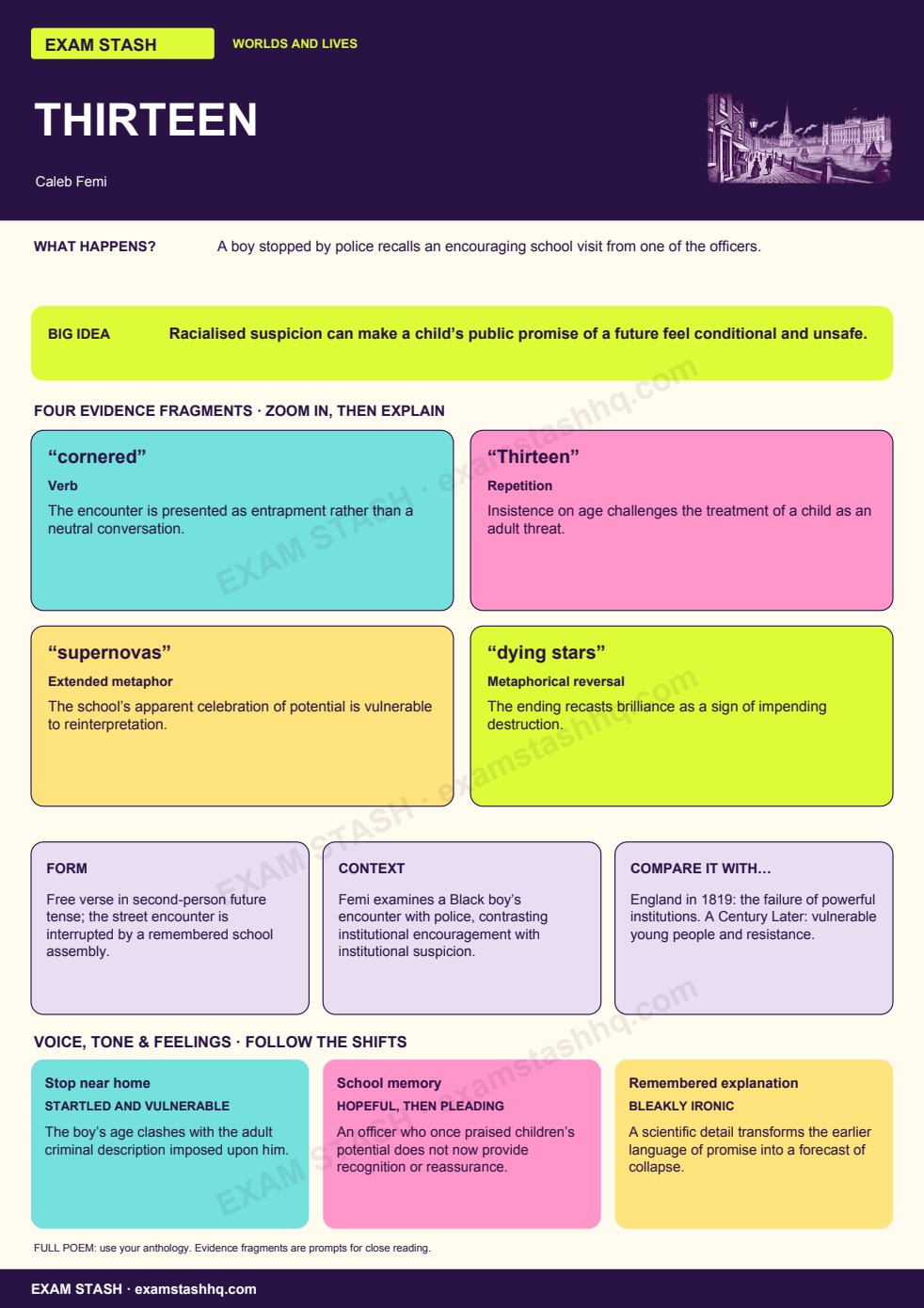
A boy stopped by police recalls an encouraging school visit from one of the officers.
Big idea
Racialised suspicion can make a child’s public promise of a future feel conditional and unsafe.
“cornered”
Verb — The encounter is presented as entrapment rather than a neutral conversation.
“Thirteen”
Repetition — Insistence on age challenges the treatment of a child as an adult threat.
“supernovas”
Extended metaphor — The school’s apparent celebration of potential is vulnerable to reinterpretation.
“dying stars”
Metaphorical reversal — The ending recasts brilliance as a sign of impending destruction.
Form
Free verse in second-person future tense; the street encounter is interrupted by a remembered school assembly.
Context
Femi examines a Black boy’s encounter with police, contrasting institutional encouragement with institutional suspicion.
Compare
England in 1819: the failure of powerful institutions. A Century Later: vulnerable young people and resistance.
Voice, tone and feelings
Stop near home · Startled and vulnerable — The boy’s age clashes with the adult criminal description imposed upon him.
School memory · Hopeful, then pleading — An officer who once praised children’s potential does not now provide recognition or reassurance.
Remembered explanation · Bleakly ironic — A scientific detail transforms the earlier language of promise into a forecast of collapse.
Recall
How does the final account of stars change the school’s earlier message?
Read the full poem in your own AQA anthology. Anthology information and source.