POWER AND CONFLICT
The Émigree
Remembered belonging can resist political exclusion while remaining selective and idealised.
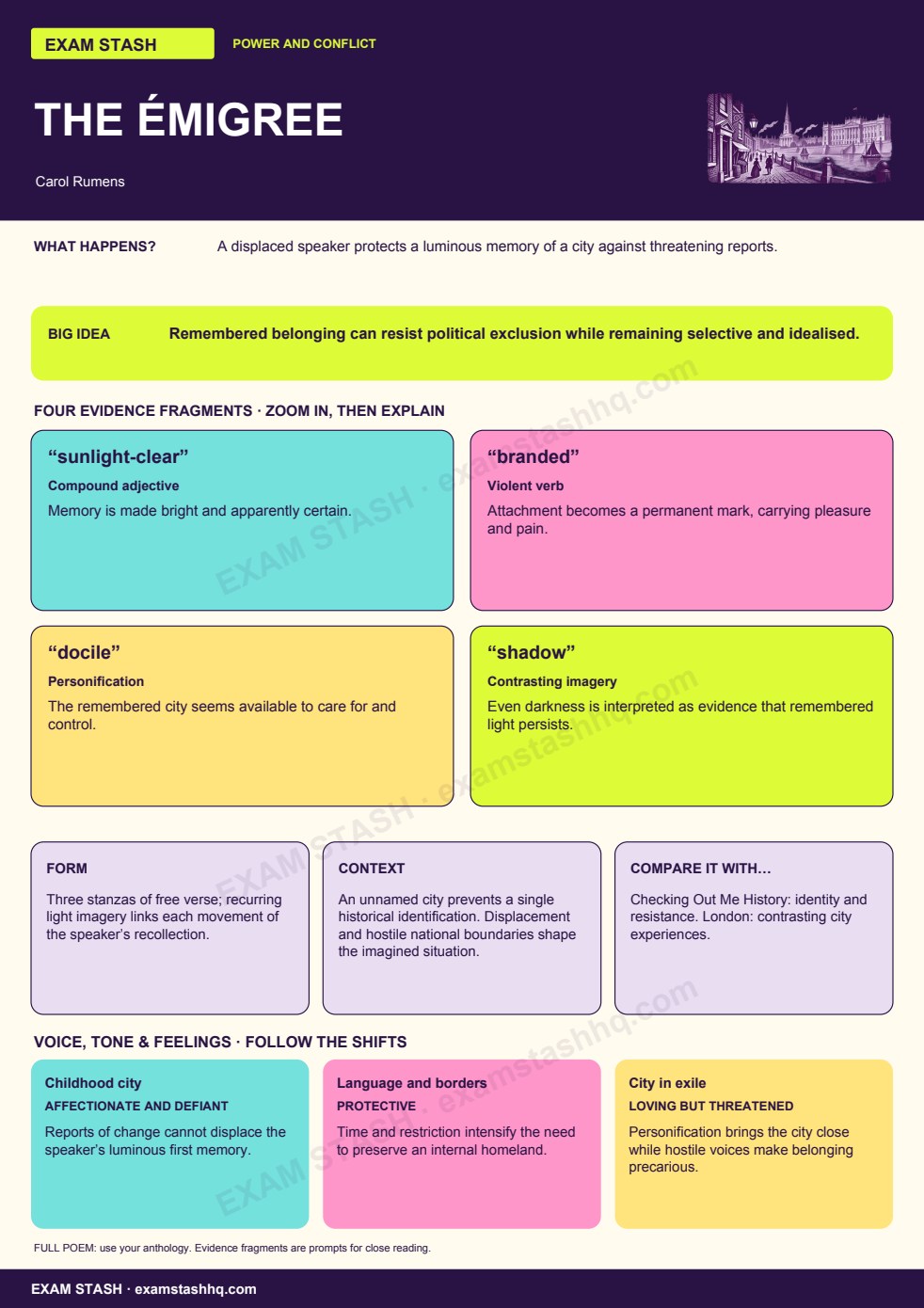
Read the accessible text and study notes
What happens?
A displaced speaker protects a luminous memory of a city against threatening reports.
Big idea
Remembered belonging can resist political exclusion while remaining selective and idealised.
“sunlight-clear”
Compound adjective — Memory is made bright and apparently certain.
“branded”
Violent verb — Attachment becomes a permanent mark, carrying pleasure and pain.
“docile”
Personification — The remembered city seems available to care for and control.
“shadow”
Contrasting imagery — Even darkness is interpreted as evidence that remembered light persists.
Form
Three stanzas of free verse; recurring light imagery links each movement of the speaker’s recollection.
Context
An unnamed city prevents a single historical identification. Displacement and hostile national boundaries shape the imagined situation.
Compare
Checking Out Me History: identity and resistance. London: contrasting city experiences.
Voice, tone and feelings
Childhood city · Affectionate and defiant — Reports of change cannot displace the speaker’s luminous first memory.
Language and borders · Protective — Time and restriction intensify the need to preserve an internal homeland.
City in exile · Loving but threatened — Personification brings the city close while hostile voices make belonging precarious.
Recall
How can a memory be both protective and idealised?
Read the full poem in your own AQA anthology. Anthology information and source.