LOVE AND RELATIONSHIPS
Sonnet 29 – ‘I think of thee!’
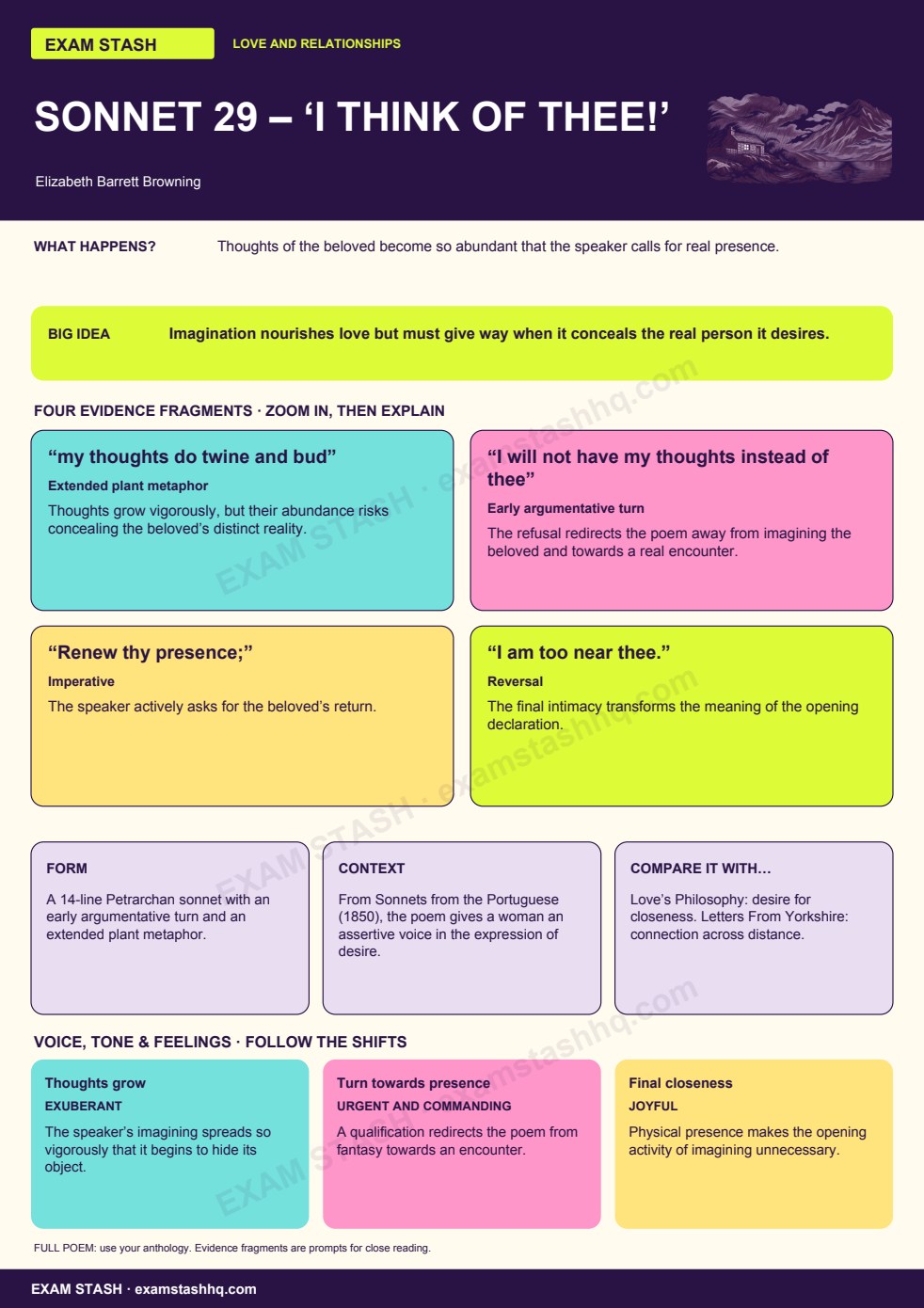
Imagination nourishes love but must give way when it conceals the real person it desires.
Read the accessible text and study notes
What happens?
Thoughts of the beloved become so abundant that the speaker calls for real presence.
Big idea
Imagination nourishes love but must give way when it conceals the real person it desires.
“my thoughts do twine and bud”
Extended plant metaphor — Thoughts grow vigorously, but their abundance risks concealing the beloved’s distinct reality.
“I will not have my thoughts instead of thee”
Early argumentative turn — The refusal redirects the poem away from imagining the beloved and towards a real encounter.
“Renew thy presence;”
Imperative — The speaker actively asks for the beloved’s return.
“I am too near thee.”
Reversal — The final intimacy transforms the meaning of the opening declaration.
Form
A 14-line Petrarchan sonnet with an early argumentative turn and an extended plant metaphor.
Context
From Sonnets from the Portuguese (1850), the poem gives a woman an assertive voice in the expression of desire.
Compare
Love’s Philosophy: desire for closeness. Letters From Yorkshire: connection across distance.
Voice, tone and feelings
Thoughts grow · Exuberant — The speaker’s imagining spreads so vigorously that it begins to hide its object.
Turn towards presence · Urgent and commanding — A qualification redirects the poem from fantasy towards an encounter.
Final closeness · Joyful — Physical presence makes the opening activity of imagining unnecessary.
Recall
Why does the speaker want thoughts to give way to presence?
Read the full poem in your own AQA anthology. Anthology information and source.