POWER AND CONFLICT
Ozymandias
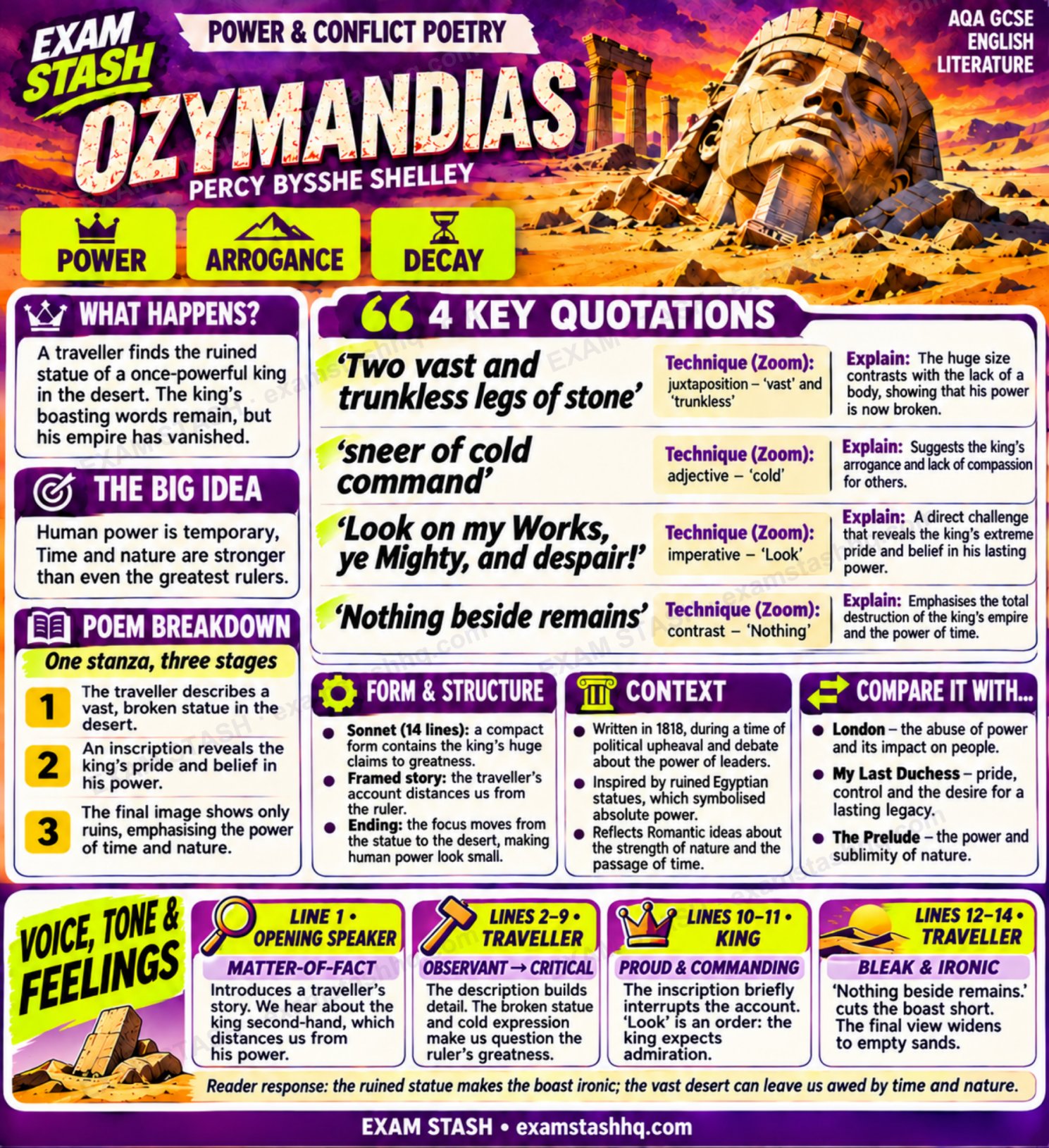
Power leaves claims behind; surviving art makes those claims vulnerable to judgement.
Read the accessible text and study notes
What happens?
A ruined statue exposes the gap between a ruler’s ambition and what survives.
Big idea
Power leaves claims behind; surviving art makes those claims vulnerable to judgement.
“Two vast and trunkless legs of stone”
Contrasting adjectives — The monument’s vast scale suggests power, but its missing body exposes that power as broken.
“sneer of cold command”
Alliteration — Hard consonants sharpen the impression of severity.
“Look on my Works, ye Mighty, and despair!”
Imperative and irony — The ruler commands admiration; the surrounding ruin makes the command an ironic warning about failure.
“Nothing beside remains.”
Abrupt sentence — A short declaration punctures the ruler’s expansive boast.
Form
A 14-line sonnet in one stanza; mainly iambic pentameter with an interwoven rhyme scheme.
Context
Shelley published the poem in 1818. The ruined monument recalls Ramesses II; its political warning reaches beyond one ruler.
Compare
My Last Duchess: controlling men and the limits of power. The Prelude: human confidence challenged.
Voice, tone and feelings
Opening encounter · Detached — The opening speaker reports a traveller, placing the ruler at several removes from the reader.
Statue and inscription · Critical, then commanding — Fragments reveal cruelty before the inscription briefly restores the ruler’s own voice.
Final landscape · Bleak and ironic — The account answers the boast with emptiness, then expands beyond the monument.
Recall
How does the ending answer the ruler’s boast?
Read the full poem in your own AQA anthology. Anthology information and source.