WORLDS AND LIVES
On an Afternoon Train from Purley to Victoria, 1955
A courteous exchange reveals the gap between declaring racial solidarity and understanding another person’s world.
Read the accessible text and study notes
What happens?
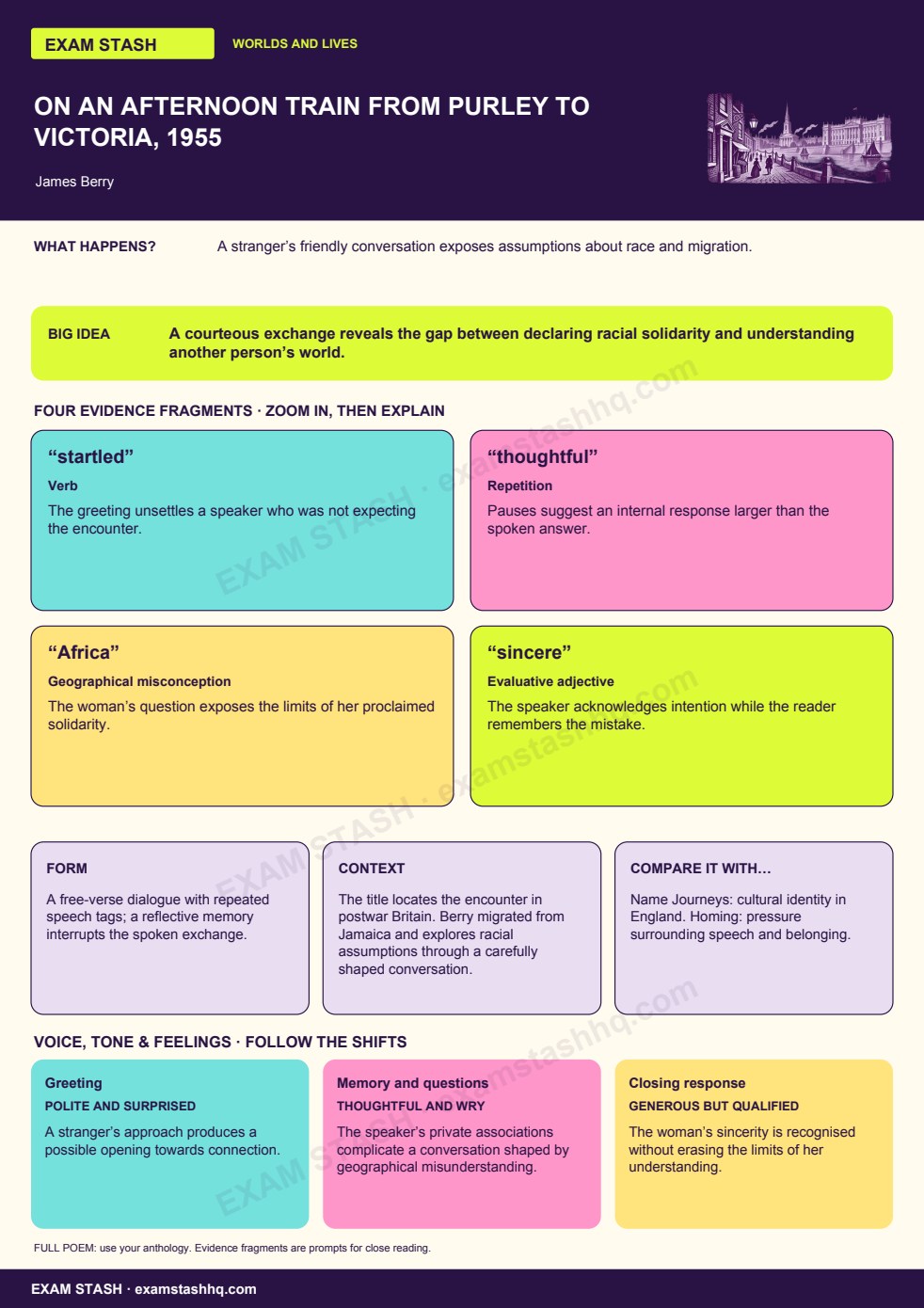
A stranger’s friendly conversation exposes assumptions about race and migration.
Big idea
A courteous exchange reveals the gap between declaring racial solidarity and understanding another person’s world.
“startled”
Verb — The greeting unsettles a speaker who was not expecting the encounter.
“thoughtful”
Repetition — Pauses suggest an internal response larger than the spoken answer.
“Africa”
Geographical misconception — The woman’s question exposes the limits of her proclaimed solidarity.
“sincere”
Evaluative adjective — The speaker acknowledges intention while the reader remembers the mistake.
Form
A free-verse dialogue with repeated speech tags; a reflective memory interrupts the spoken exchange.
Context
The title locates the encounter in postwar Britain. Berry migrated from Jamaica and explores racial assumptions through a carefully shaped conversation.
Compare
Name Journeys: cultural identity in England. Homing: pressure surrounding speech and belonging.
Voice, tone and feelings
Greeting · Polite and surprised — A stranger’s approach produces a possible opening towards connection.
Memory and questions · Thoughtful and wry — The speaker’s private associations complicate a conversation shaped by geographical misunderstanding.
Closing response · Generous but qualified — The woman’s sincerity is recognised without erasing the limits of her understanding.
Recall
Why does the final assessment of the stranger remain qualified?
Read the full poem in your own AQA anthology. Anthology information and source.