WORLDS AND LIVES
Like an Heiress
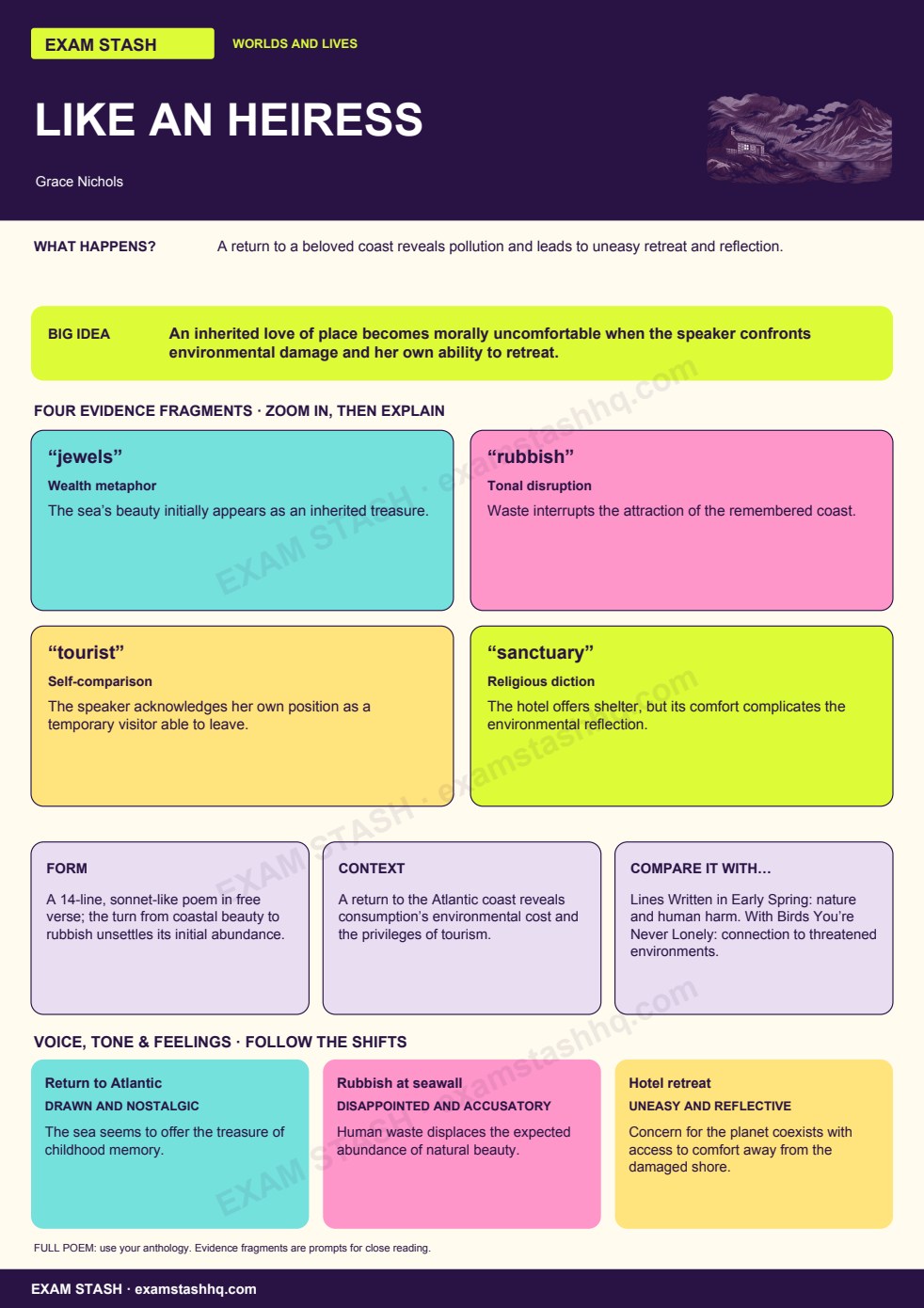
An inherited love of place becomes morally uncomfortable when the speaker confronts environmental damage and her own ability to retreat.
Read the accessible text and study notes
What happens?
A return to a beloved coast reveals pollution and leads to uneasy retreat and reflection.
Big idea
An inherited love of place becomes morally uncomfortable when the speaker confronts environmental damage and her own ability to retreat.
“jewels”
Wealth metaphor — The sea’s beauty initially appears as an inherited treasure.
“rubbish”
Tonal disruption — Waste interrupts the attraction of the remembered coast.
“tourist”
Self-comparison — The speaker acknowledges her own position as a temporary visitor able to leave.
“sanctuary”
Religious diction — The hotel offers shelter, but its comfort complicates the environmental reflection.
Form
A 14-line, sonnet-like poem in free verse; the turn from coastal beauty to rubbish unsettles its initial abundance.
Context
A return to the Atlantic coast reveals consumption’s environmental cost and the privileges of tourism.
Compare
Lines Written in Early Spring: nature and human harm. With Birds You’re Never Lonely: connection to threatened environments.
Voice, tone and feelings
Return to Atlantic · Drawn and nostalgic — The sea seems to offer the treasure of childhood memory.
Rubbish at seawall · Disappointed and accusatory — Human waste displaces the expected abundance of natural beauty.
Hotel retreat · Uneasy and reflective — Concern for the planet coexists with access to comfort away from the damaged shore.
Recall
Why does the retreat to a hotel complicate the speaker’s concern?
Read the full poem in your own AQA anthology. Anthology information and source.