LOVE AND RELATIONSHIPS
Follower
Admiration for a parent’s mastery develops into an uneasy recognition that dependence can reverse.
Read the accessible text and study notes
What happens?
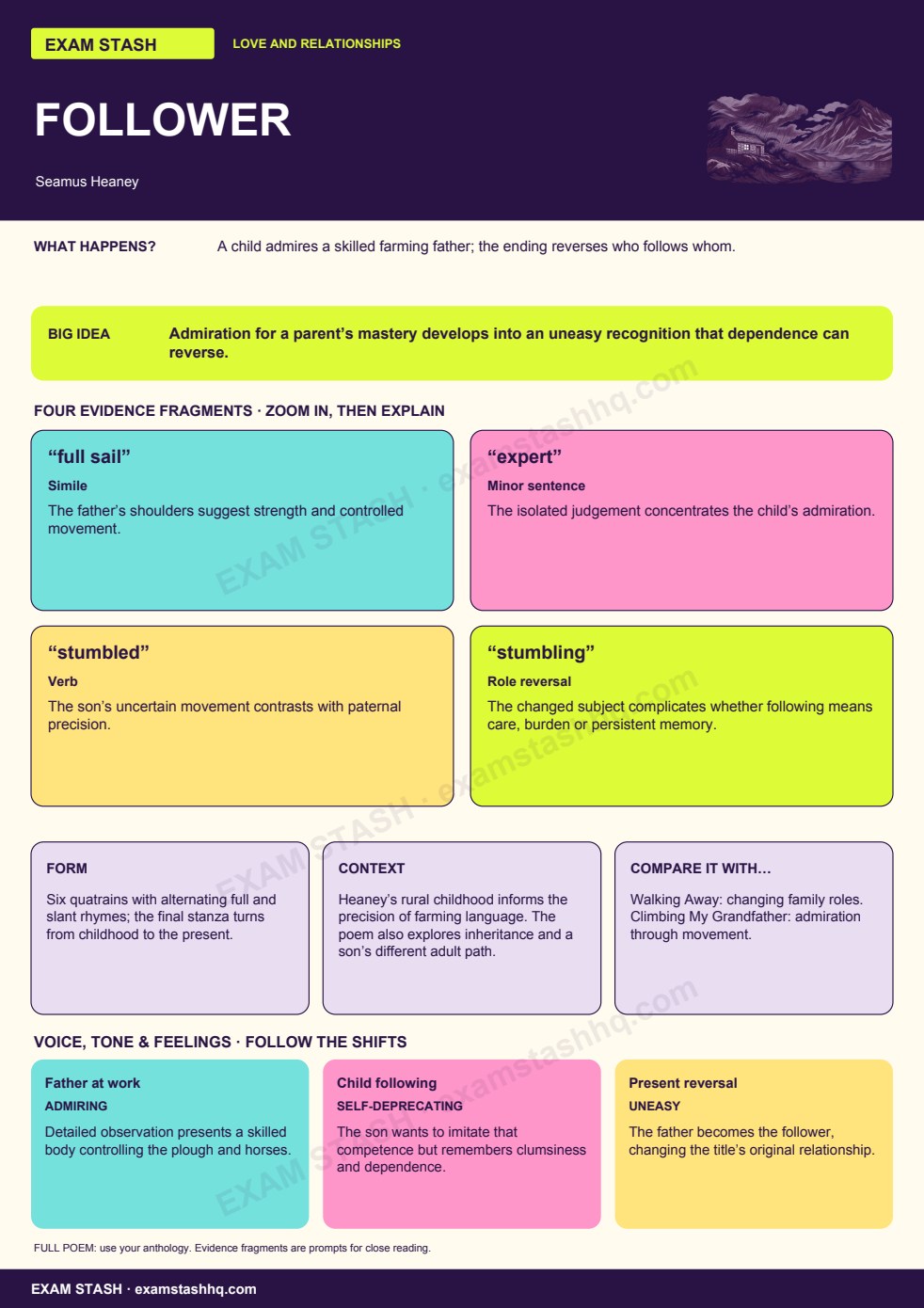
A child admires a skilled farming father; the ending reverses who follows whom.
Big idea
Admiration for a parent’s mastery develops into an uneasy recognition that dependence can reverse.
“full sail”
Simile — The father’s shoulders suggest strength and controlled movement.
“expert”
Minor sentence — The isolated judgement concentrates the child’s admiration.
“stumbled”
Verb — The son’s uncertain movement contrasts with paternal precision.
“stumbling”
Role reversal — The changed subject complicates whether following means care, burden or persistent memory.
Form
Six quatrains with alternating full and slant rhymes; the final stanza turns from childhood to the present.
Context
Heaney’s rural childhood informs the precision of farming language. The poem also explores inheritance and a son’s different adult path.
Compare
Walking Away: changing family roles. Climbing My Grandfather: admiration through movement.
Voice, tone and feelings
Father at work · Admiring — Detailed observation presents a skilled body controlling the plough and horses.
Child following · Self-deprecating — The son wants to imitate that competence but remembers clumsiness and dependence.
Present reversal · Uneasy — The father becomes the follower, changing the title’s original relationship.
Recall
How does the ending change the meaning of the title?
Read the full poem in your own AQA anthology. Anthology information and source.