COMPARISON
Ozymandias / London
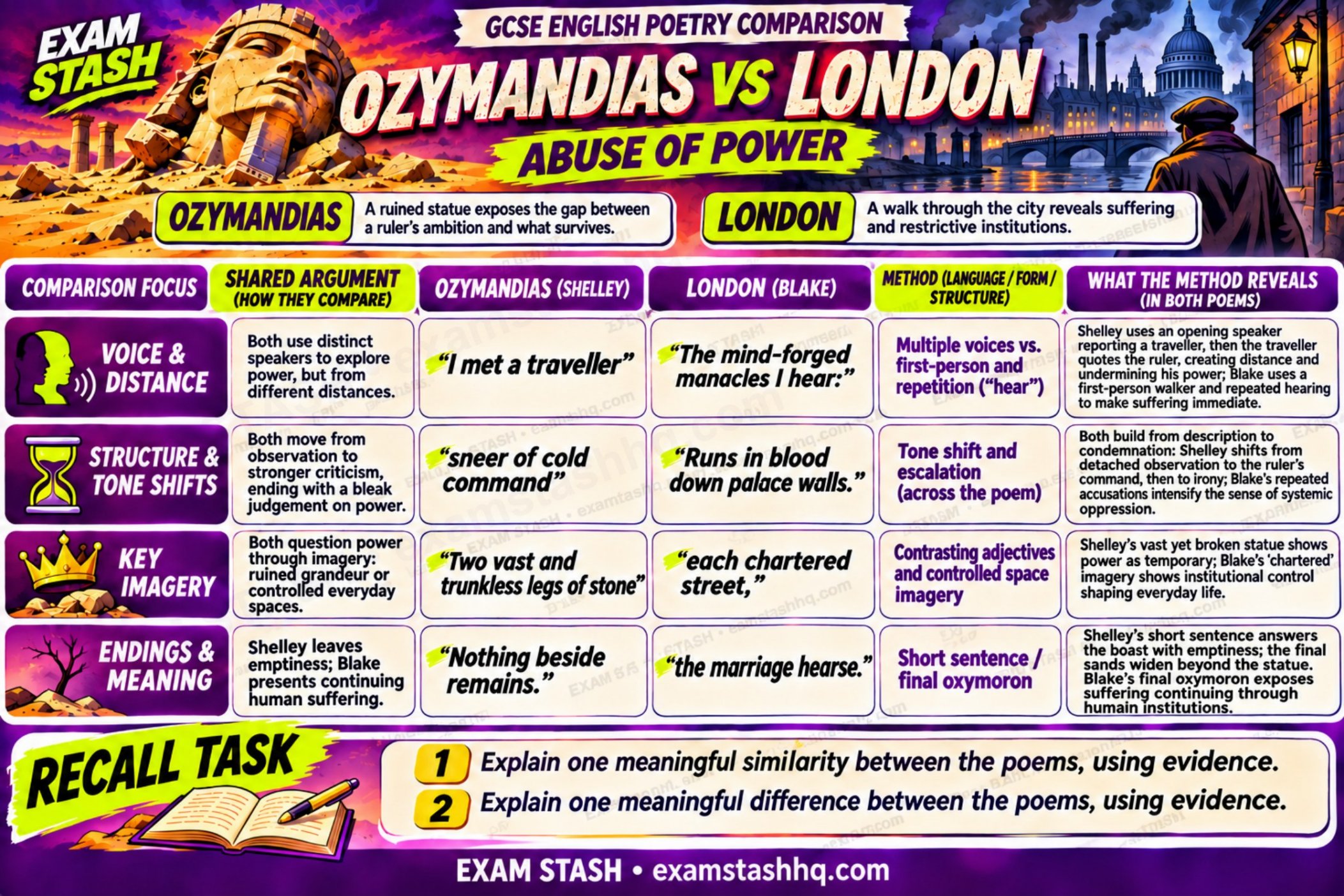
Landscape comparison: voice, power, ownership, structure and endings.
Read the accessible text and study notes
Both poems expose abuse of power. Shelley dismantles its legacy; Blake makes its ongoing human cost audible.
VOICE & DISTANCE
Ozymandias: “I met a traveller” — Shelley’s first-person opening hands the account to another voice. The king reaches us through a traveller, a sculpture and an inscription. The frame distances us from his authority.
London: “I wander” — Blake’s first-person walker witnesses the city directly. His repeated hearing and seeing make oppression immediate, although this is a crafted poetic speaker rather than an unfiltered diary.
CONTROL & OWNERSHIP
Ozymandias: “king of kings” — The title and boast assert unmatched personal authority. That confidence survives only as an inscription beside ruins: a ruler cannot dictate his future reception.
London: “chartered” — Repetition applies regulation and ownership to streets and even the river. Institutional control seems pervasive; the natural world is drawn into the social system.
HOW POWER WORKS
Ozymandias: “sneer of cold command” — The sculpted expression preserves contempt. The artist records the ruler’s passions, letting art expose the character of authority after the regime has vanished.
London: “mind-forged manacles” — The metaphor turns mental restriction into chains. Power operates through internalised limits as well as physical institutions; consider what makes people accept confinement.
STRUCTURE & TONE
Ozymandias: “Nothing beside remains” — The brief statement checks the boast. A 14-line sonnet moves from fragments to the king’s voice, then to empty landscape: apparent grandeur ends in an ironic reversal.
London: “In every” — Anaphora accumulates suffering across four quatrains. Regular rhyme and recurring patterns can suggest enclosure; the walk offers no clear escape from oppression.
ENDING & IMPLICATION
Ozymandias: “lone and level sands” — The final view widens beyond the monument. Time and landscape reduce claims of permanence; the poem makes a distant example relevant to the reader’s own political world.
London: “marriage hearse” — The compressed collision of union and death ends with damaged social continuity. Blake leaves the reader inside a living city whose institutions threaten its future.