AN INSPECTOR CALLS
Sybil Birling
Mrs Birling turns social authority into a judgement about who deserves help. The order of revelations exposes the limits of her certainty.
Read the accessible text and study notes
Sybil Birling
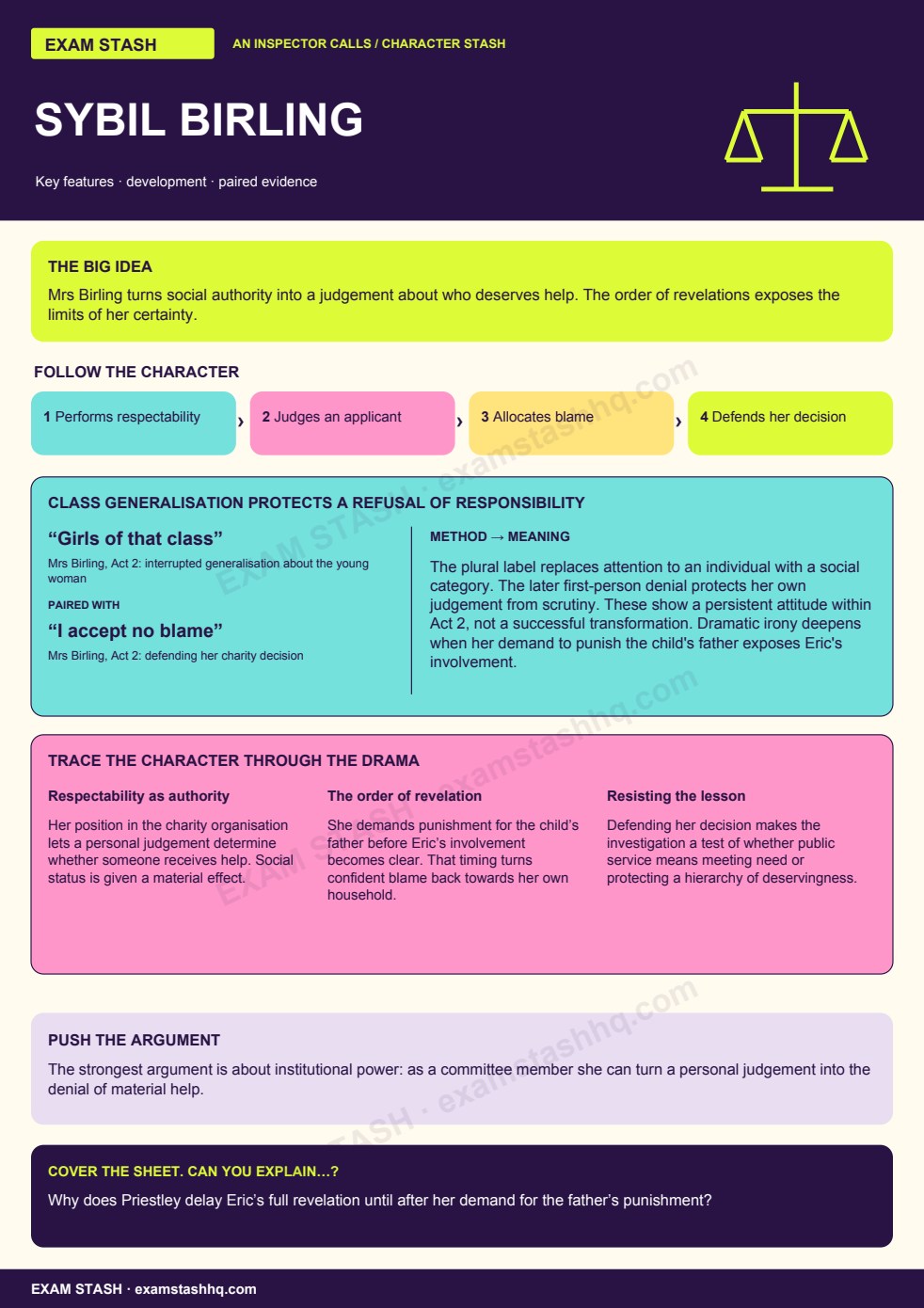
Mrs Birling turns social authority into a judgement about who deserves help. The order of revelations exposes the limits of her certainty.
Performs respectability → Judges an applicant → Allocates blame → Defends her decision
Class generalisation protects a refusal of responsibility
“Girls of that class” — Mrs Birling, Act 2: interrupted generalisation about the young woman
paired with “I accept no blame” — Mrs Birling, Act 2: defending her charity decision
The plural label replaces attention to an individual with a social category. The later first-person denial protects her own judgement from scrutiny. These show a persistent attitude within Act 2, not a successful transformation. Dramatic irony deepens when her demand to punish the child's father exposes Eric's involvement.
Push the argument
The strongest argument is about institutional power: as a committee member she can turn a personal judgement into the denial of material help.
Recall
Why does Priestley delay Eric’s full revelation until after her demand for the father’s punishment?
Trace the drama
Respectability as authority
Her position in the charity organisation lets a personal judgement determine whether someone receives help. Social status is given a material effect.
The order of revelation
She demands punishment for the child’s father before Eric’s involvement becomes clear. That timing turns confident blame back towards her own household.
Resisting the lesson
Defending her decision makes the investigation a test of whether public service means meeting need or protecting a hierarchy of deservingness.
Evidence sources
Explore the play. Scene locations are used because page numbers vary by edition.