MACBETH
Lady Macduff
Lady Macduff gives political violence a domestic setting. Her criticism reveals the cost of resistance for people left vulnerable.
Read the accessible text and study notes
Lady Macduff
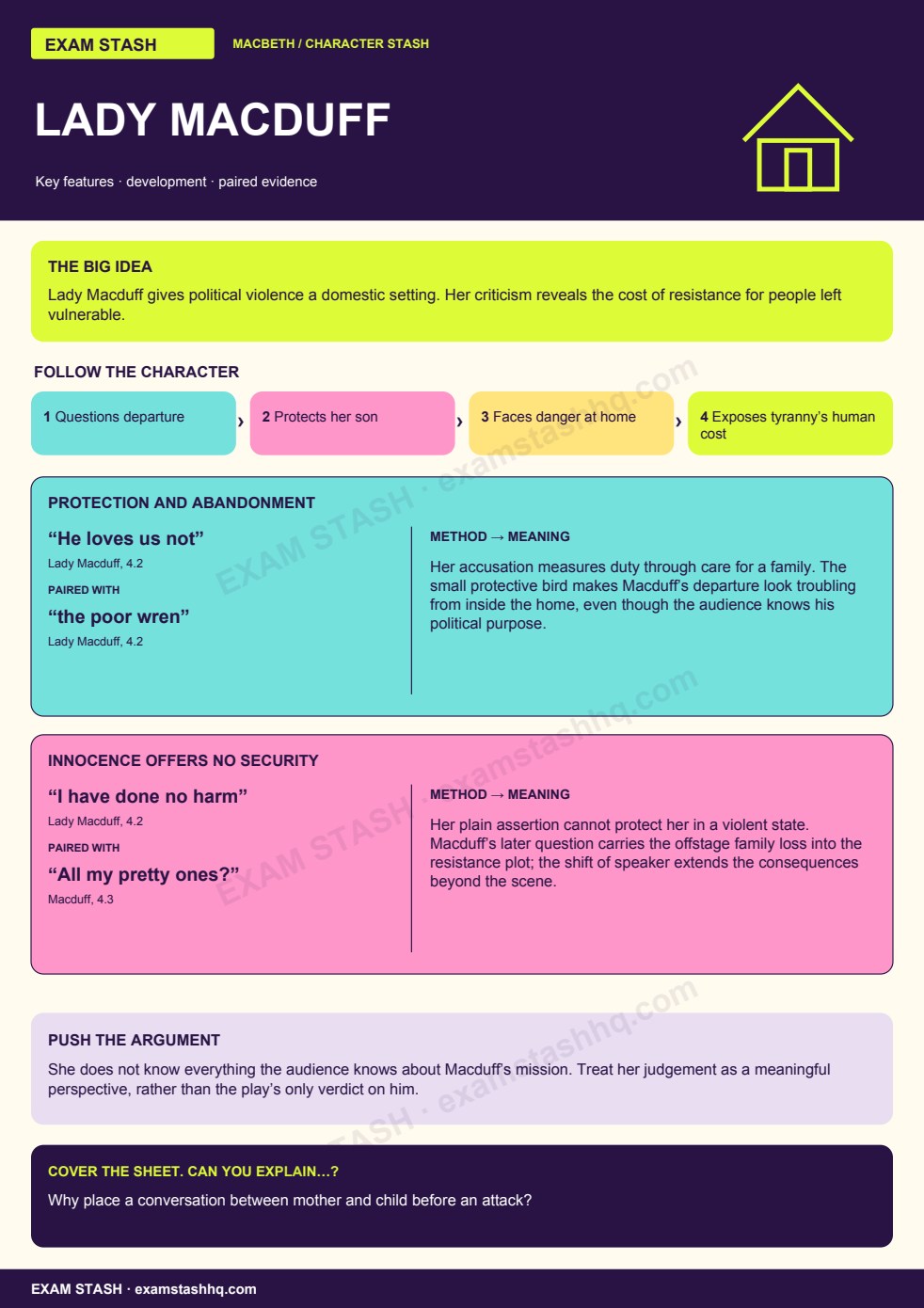
Lady Macduff gives political violence a domestic setting. Her criticism reveals the cost of resistance for people left vulnerable.
Questions departure → Protects her son → Faces danger at home → Exposes tyranny’s human cost
Protection and abandonment
“He loves us not” — Lady Macduff, 4.2
paired with “the poor wren” — Lady Macduff, 4.2
Her accusation measures duty through care for a family. The small protective bird makes Macduff’s departure look troubling from inside the home, even though the audience knows his political purpose.
Innocence offers no security
“I have done no harm” — Lady Macduff, 4.2
paired with “All my pretty ones?” — Macduff, 4.3
Her plain assertion cannot protect her in a violent state. Macduff’s later question carries the offstage family loss into the resistance plot; the shift of speaker extends the consequences beyond the scene.
Push the argument
She does not know everything the audience knows about Macduff’s mission. Treat her judgement as a meaningful perspective, rather than the play’s only verdict on him.
Recall
Why place a conversation between mother and child before an attack?
Read Macbeth. Scene locations are used because page numbers vary by edition.