MACBETH
Lady Macbeth
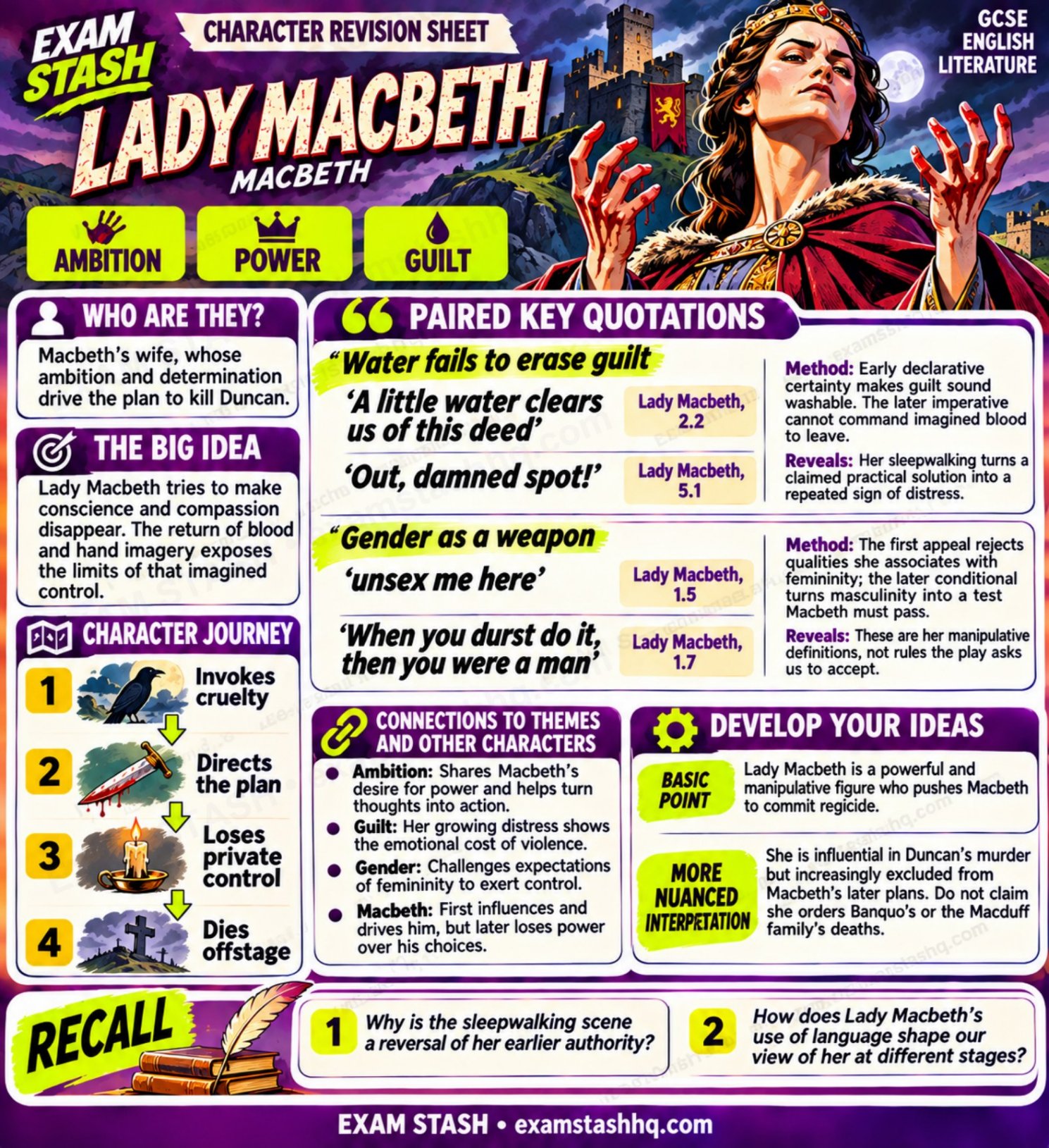
Lady Macbeth tries to make conscience and compassion disappear. The return of blood and hand imagery exposes the limits of that imagined control.
Read the accessible text and study notes
Lady Macbeth
Lady Macbeth tries to make conscience and compassion disappear. The return of blood and hand imagery exposes the limits of that imagined control.
Invokes cruelty → Directs the plan → Loses private control → Dies offstage
Water fails to erase guilt
“A little water clears us of this deed” — Lady Macbeth, 2.2
paired with “Out, damned spot!” — Lady Macbeth, 5.1
Early declarative certainty makes guilt sound washable. The later imperative cannot command imagined blood to leave. Her sleepwalking turns a claimed practical solution into a repeated sign of distress.
Gender as a weapon
“unsex me here” — Lady Macbeth, 1.5
paired with “When you durst do it, then you were a man” — Lady Macbeth, 1.7
The first appeal rejects qualities she associates with femininity; the later conditional turns masculinity into a test Macbeth must pass. These are her manipulative definitions, not rules the play asks us to accept.
Push the argument
She is influential in Duncan’s murder but increasingly excluded from Macbeth’s later plans. Do not claim she orders Banquo’s or the Macduff family’s deaths.
Recall
Why is the sleepwalking scene a reversal of her earlier authority?
Read Macbeth. Scene locations are used because page numbers vary by edition.