MACBETH
Banquo
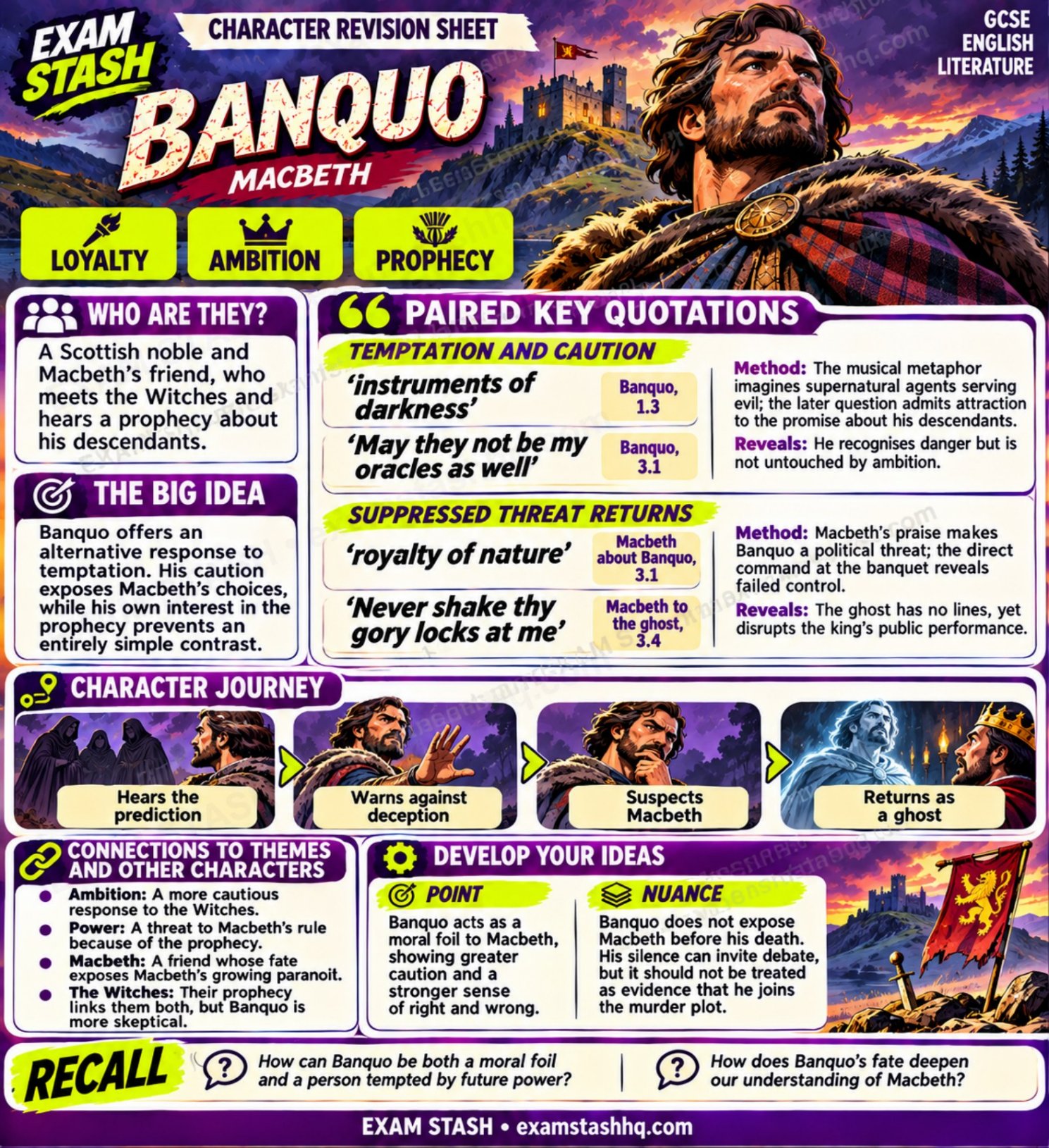
Banquo offers an alternative response to temptation. His caution exposes Macbeth’s choices, while his own interest in the prophecy prevents an entirely simple contrast.
Read the accessible text and study notes
Banquo
Banquo offers an alternative response to temptation. His caution exposes Macbeth’s choices, while his own interest in the prophecy prevents an entirely simple contrast.
Hears the prediction → Warns against deception → Suspects Macbeth → Returns as a ghost
Temptation and caution
“instruments of darkness” — Banquo, 1.3
paired with “May they not be my oracles as well” — Banquo, 3.1
The musical metaphor imagines supernatural agents serving evil; the later question admits attraction to the promise about his descendants. He recognises danger but is not untouched by ambition.
Suppressed threat returns
“royalty of nature” — Macbeth about Banquo, 3.1
paired with “Never shake thy gory locks at me” — Macbeth to the ghost, 3.4
Macbeth’s praise makes Banquo a political threat; the direct command at the banquet reveals failed control. The ghost has no lines, yet disrupts the king’s public performance.
Push the argument
Banquo does not expose Macbeth before his death. His silence can invite debate, but it should not be treated as evidence that he joins the murder plot.
Recall
How can Banquo be both a moral foil and a person tempted by future power?
Read Macbeth. Scene locations are used because page numbers vary by edition.